

Convert Your Garage into an Office, Gym, or Studio in Los Angeles (2026)
Meta Title: Garage to Office, Gym, or Studio Conversion in LA (2026)
Meta Description: Turn your garage into a home office, gym, or studio in LA — electrical, insulation, soundproofing, flooring, permits, and why a flex space isn’t an ADU.
Not every garage conversion is an ADU. Many Los Angeles homeowners convert the garage into a home office, gym, studio, or playroom — a flex space that adds room to your own home without a kitchen or bathroom. This guide covers what each use needs, the finishes that work, and when a permit is required.
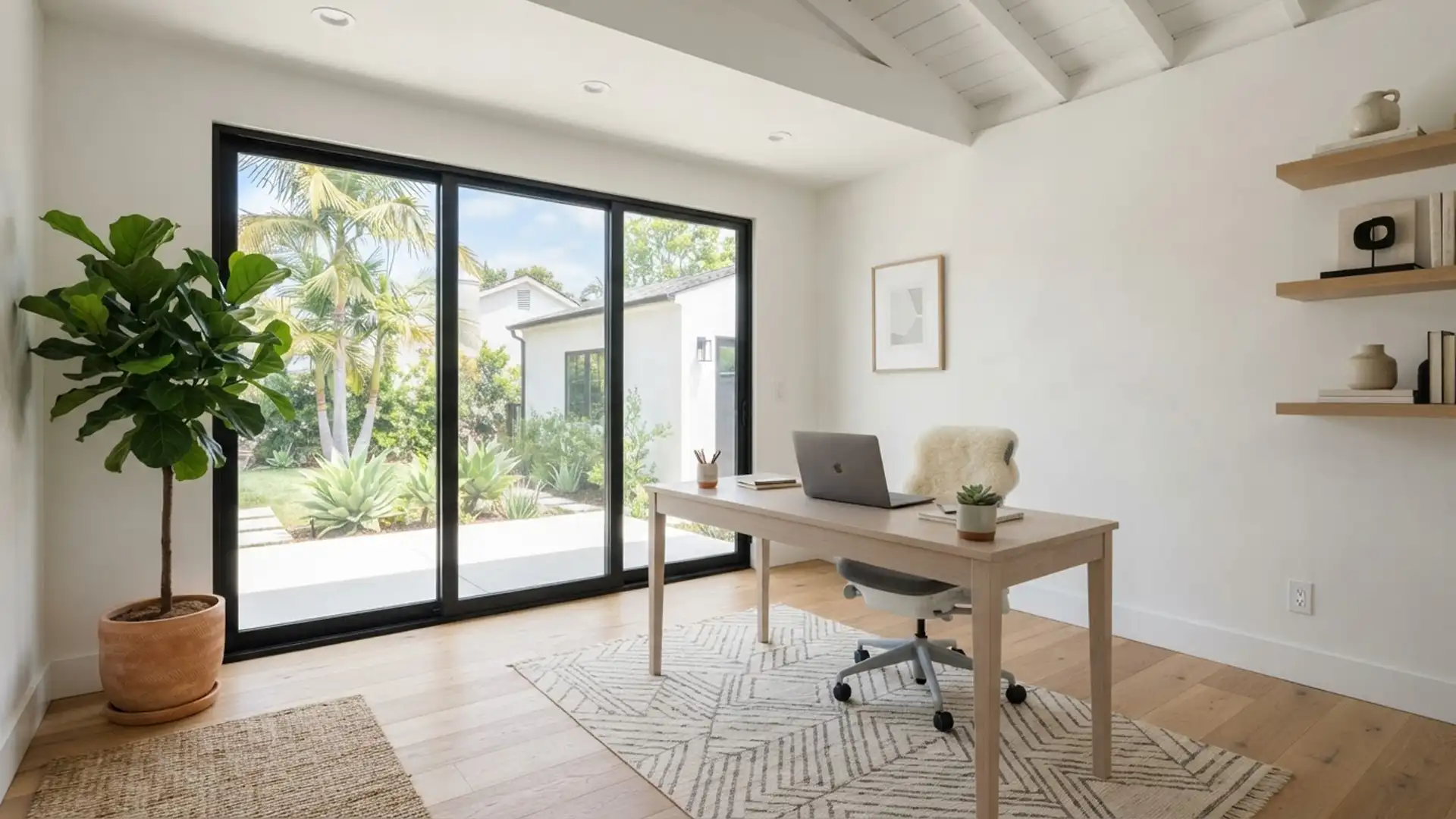
Garage to home office
For a comfortable, code-safe home office:
- Check the breaker box has capacity for your load — one or two computers, lighting, a fan, and a TV.
- Have a licensed electrician install outlets, switches, and lighting.
- Insulate the walls and ceiling — it also blocks outside noise.
- Add climate control (HVAC) so the space is usable year-round.
- Bring in light: windows, a skylight, recessed ceiling lighting, or a glass garage door.
- Add soundproofing if you take calls or need quiet.
Garage to home gym
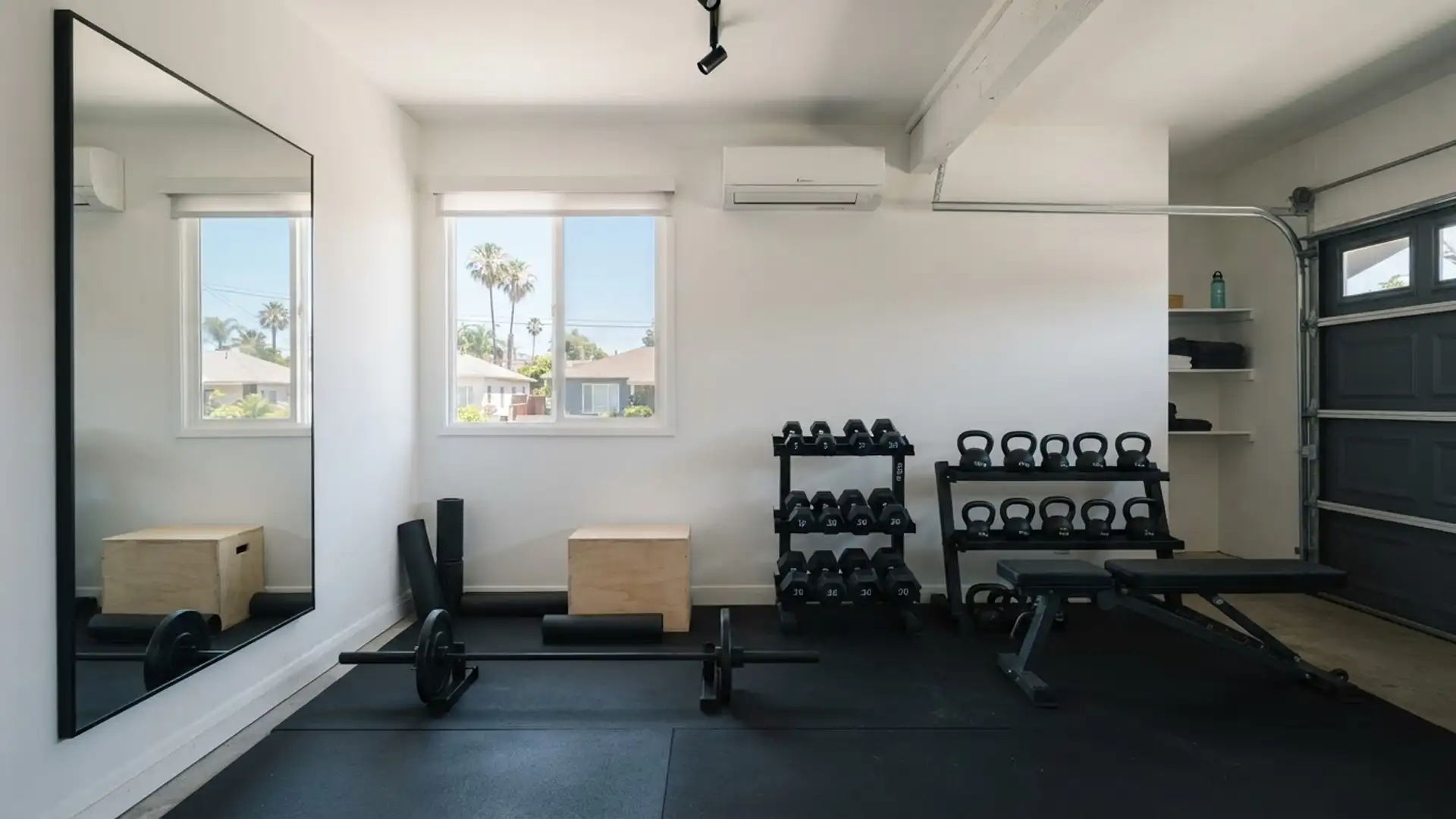
A garage makes a great home gym with the right setup:
- Flooring: rubber (durable, shock-absorbing, with some sound dampening), foam or padded tiles to protect joints, or epoxy for traction.
- Ventilation: essential for air quality and to prevent mold — floor fans and an openable glass garage door help.
- Climate: an A/C unit and ceiling fans.
- Power: plan wall outlets for your equipment; often only minimal rewiring is needed.
- Mirrors: placed on the walls to expand the space visually and let you check your form.
Garage to studio (music, recording, art, or yoga)
A studio has two separate jobs: soundproofing (keeping sound from leaking out to the neighborhood) and acoustic treatment (making the sound inside the room good). They are not the same thing. Here is what matters for a garage studio:
- Soundproofing — mass is the foundation; each doubling of mass cuts sound transmission by about 6 dB. The strongest results come from a decoupled room-in-room double wall with about a 1-inch air gap, two layers of 5/8-inch drywall plus plywood for mass, and R13 fiberglass in the cavity — a build that can reach roughly STC 63. Decoupling (double walls, resilient channels, or acoustic clips) stops vibration from traveling through solid framing.
- Avoid the triple-leaf trap — adding a layer of drywall inside the air gap actually hurts isolation; a double wall with drywall only on the outer faces tests far better (about STC 50 to 63) than one drywalled on the inner faces too (about STC 40).
- Doors and ceiling — use a heavy studio-rated door with tight seals; build an independent ceiling frame that is not tied to the garage trusses, and seal every seam.
- Acoustic treatment — absorption panels, ceiling clouds, bass traps in the corners, and diffusers balance the sound inside the room.
- Ventilation and climate — a sealed studio still needs air: an ERV (about 130 to 150 CFM) brings in fresh air, and a ductless mini-split plus a dehumidifier handle temperature without leaky ductwork. Keep HVAC quiet with oversized ducts (airflow 100 to 300 FPM, never above 500), gentle bends instead of 90-degree turns at the registers, and baffle boxes so sound does not escape through the vents. Plan about 15 CFM of fresh air per person.
- Lighting — for an art studio, skylights or solar tubes plus LEDs and a lightbox; for a yoga studio, large windows (or windows set into the garage door), frosted glass for privacy, and soft white light rather than harsh fluorescents.
- Flooring — for yoga or dance, skip carpet; tile, hardwood, laminate with a little give, cork, bamboo, or rubber mats give grip and cushioning. For a music studio, an acoustic underlayment under an engineered-wood floor over the slab reduces vibration.
- Electrical — dedicated circuits and outlets for your gear, installed by a licensed electrician; a star grounding scheme helps prevent hum and interference.
Garage to playroom, home theater, or hobby room
These rooms are about comfort and power:
- New lighting suited to the room.
- Climate control — HVAC, fans, and insulation.
- Insulation plus drywall to finish the walls.
- An electrical upgrade — for example, enough power for 4K consoles or home-theater gear.
Solutions that apply to any garage conversion
- Climate: HVAC, ceiling fans, and A/C — a ductless mini-split is a common choice for a garage.
- Flooring: epoxy, ceramic tile, luxury vinyl plank (LVP), polished sealed concrete, or stained concrete for an industrial look.
- Insulation: foam insulation on walls and ceiling, then drywall and paint.
- The garage door: seal the opening into a fully framed wall, install a smaller door, or replace it with a glass door or windows for light.
- Storage: wall hooks and shelves, built-in cabinetry and workbenches, or split the garage to keep part for storage (or add an outdoor shed).
Do you need a permit?
A permit is required if the project involves structural changes, plumbing, or converting the garage into living space. If you are not building new walls or running plumbing, the full architectural plan-check may not be needed — a contractor can pull a city permit and start. Legally, living area means habitable, conditioned space; garages and other non-conditioned structures are not counted as living area until they are converted. Confirm the requirements for your project with LADBS.
A flex space is not an ADU
Here is the key distinction: the moment you turn the garage into a rental unit, it is legally an ADU, which the City of Los Angeles requires to have a full bathroom, kitchen, and living areas. Those wet rooms — a bathroom and kitchen — are the defining feature of an ADU and require sewer lines, a water heater, and plumbing. Without them, the garage stays a flex space (home office, gym, studio) and cannot legally be rented as a dwelling. If renting it out is your goal, see our garage-to-ADU conversion guide.
Build your flex space right
Whether it is an office, a gym, or a studio, the work should be done to code and permitted where required. As a licensed Class B general contractor (CSLB #1148495), Kobzev Pro handles the electrical, insulation, climate, finishes, and any permits — see our garage conversion service. Final permit requirements and approvals are set by LADBS.
Based in Van Nuys, in the heart of the San Fernando Valley, Kobzev Pro serves Los Angeles — including Sherman Oaks, Studio City, Encino, and Woodland Hills — and Southern California. We travel up to about 150 miles for the right project, including Ventura, Santa Barbara, Orange County, and the Inland Empire.
Book a free on-site visit to plan your garage office, gym, or studio — or get an instant number with our ADU cost calculator. Licensed general contractor, CSLB #1148495.
Frequently asked questions
How do I soundproof a garage so I do not disturb neighbors during band practice?
Build mass and decoupling: a room-in-room double wall with an air gap, two layers of 5/8-inch drywall plus plywood, and insulation in the cavity (a build that can reach about STC 63), plus a sealed studio-rated door and an independent ceiling.
What is the difference between soundproofing and acoustic treatment?
Soundproofing keeps sound from leaking out of the room; acoustic treatment (panels, bass traps, diffusers) makes the sound inside the room good. You usually want both.
How do I ventilate a sealed studio without losing soundproofing?
Use an ERV for fresh air and a ductless mini-split for temperature, with oversized quiet ducts and baffle boxes so sound does not escape through the vents.
What flooring is best for a yoga studio?
Avoid carpet; tile, hardwood, laminate with a little give, cork, bamboo, or rubber mats give grip and cushioning.
Do I need a permit to convert my garage into an office or gym?
A permit is required if there are structural changes or plumbing. A non-structural conversion with no plumbing may only need a city permit rather than a full plan check. Confirm with LADBS.
What is the best flooring for a garage gym?
Rubber flooring is popular for durability, shock absorption, and some sound dampening; epoxy gives good traction; foam or padded tiles protect joints.
Do I need insulation and HVAC for a home office?
They are recommended — insulation and HVAC make the space comfortable year-round, and insulation also helps block outside noise.
Do I need soundproofing for a music studio?
Yes — soundproofing the walls and doors keeps the sound inside.
Can I keep part of the garage for storage?
Yes. You can split the garage and keep part for storage, or add an outdoor shed.
Should I replace the garage door?
You can seal it into a full framed wall, install a smaller door, or use a glass door or windows for light — depending on the look and function you want.
Can I use my garage during the remodel?
Generally not during active construction; ask your contractor for a schedule and any phasing options.
How long does a garage remodel take?
It depends on the scope — a non-structural flex-space conversion is faster than a full ADU. Your contractor can give a timeline after seeing the space.
Can I convert my garage into a legal rental (ADU)?
Yes, but then it must include a kitchen and bathroom and meet ADU code; without those it stays a flex space you cannot rent as a dwelling. See our garage-to-ADU guide.